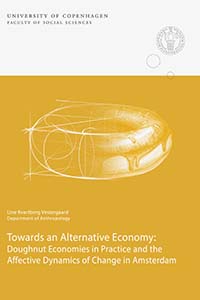
Towards an Alternative Economy: Doughnut Economies in Practice and the Affective Dynamics of Change in Amsterdam
Public defence of PhD thesis by Line Kvartborg Vestergaard.
In recent years, a number of new visionary economic models and proposals have emerged as alternative and forceful reactions to mainstream economic thought and practice, and to the ecological and social crises that threaten life forms on Earth. One such influential model is Doughnut Economics coined by the economist Kate Raworth in 2012 and presented in a book in 2017, now published in more than twenty languages. This economic model lays out principles for an alternative economy organised within planetary boundaries and centred on human well-being - visualised through a doughnut-shaped icon.
This alternative economic model or vision can be viewed conceptually as a distinct “transition vision” (Escobar 2018) that heralds new ways of being and acting for humanity and stands as a defining marker of the present era.
Based on nine months of ethnographic fieldwork in 2022-2023 in Amsterdam – the first city in the world to apply “the Doughnut,” as it is often referred to, on an urban scale – this dissertation explores how the model and its grand visions are pursued and enacted in practice by various actors within both the Municipality of Amsterdam and in civil society. From an anthropological perspective, the dissertation traces how a transition vision with ontological implications is interpreted, adapted, negotiated, and utilised by differently situated actors in the city of Amsterdam. In other words, what happens when ‘the Doughnut’ hits the ground in the Dutch capital and is pursued and enacted in practices and relations? Moreover, which dynamics and effects emerge as a result of these enactments?
The dissertation answers these questions by illuminating the variegated practices, interpretations, and relations through which actors pursue and enact alternative economies. It demonstrates how affect plays a pivotal role in the production and circulation of Doughnut Economics and the social coalescences that form around it. As such, the model is affectively shaped and adapted by people through their aspirations and everyday practices for other ways of being and, hence, other economies. Furthermore, the dissertation argues that the model of Doughnut Economics carries ethical affordances that can generate new forms of awareness, belonging, and relations, as well as new practices. Some actors become propelled to engage in acts of “economic ethicising” seeking to implement and advocate for Doughnut Economics in their neighbourhoods and workplaces. The dissertation traces the effects of these ethical practices and highlights the tensions, paradoxes, challenges, adaptions, and emergent ways of thinking, acting and being they produce.
Although the anticipated transformation never materialised in Amsterdam - at least not in the ways that dominant discourses portrayed – this ethnographic study shows that these enactments nonetheless had ‘effects’. Hence, far from concluding that nothing happened, the dissertation illuminates the affective, subtle, elusive, and not-fully-formed effects arising from enactments of Doughnut Economics.
Taken together, the dissertation advances an anthropology of transition visions. It foregrounds how a transition vision such as Doughnut Economics operates as ideas, tools, and lived practices that seek to reorient ways of thinking, being, and acting; how affects and ethics are constitutive of these enactments; and how state and civil society actors, in variegated - at times tension-full – ways, produce alternative economies in the making. The widespread interest among many actors and sectors in transitioning to alternative ways of organising societies and economies calls for further scholarly engagement with such models and visions. In particular, the insights offered in this dissertation demonstrate the need for greater anthropological attention to economic visions such as Doughnut Economics – and, not least, to the actors enacting them – to understand how such visions circulate and shape change-making efforts across contexts.
 Assessment committee
-
Professor Stine Krøijer, Department of Anthropology, University of Copenhagen, Denmark (chair)
-
Professor Christina Garsten, Swedish Collegium for Advanced Study (SCAS), Uppsala University, Sweden
-
Associate Professor Jakob Krause-Jensen, Department of Educational Anthropology and Educational Psychology, Aarhus University (Denmark).
Moderator of the defence
- Ayo Wahlberg, Head of Department, Anthropology, UCPH.
Supervisor
- Kasper Tang Vangkilde, Associate Professor, Department of Anthropology, UCPH.
Informal reception
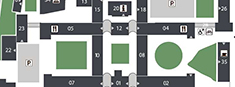
After the defence, the department will host an informal reception in the Ethnographic Exploratory, Øster Farimagsgade 5, building 4, room 4.1.12.
Zoom Meeting ID: 669 5660 8692 and Passcode: 095147.