
When the green transition hits the backyard: New research project to strengthen democratic ownership
We broadly support the green transition. But when it changes our landscape, our daily lives, or our local communities, difficult dilemmas arise. It is this tension that a new research project from the Department of Anthropology is investigating.
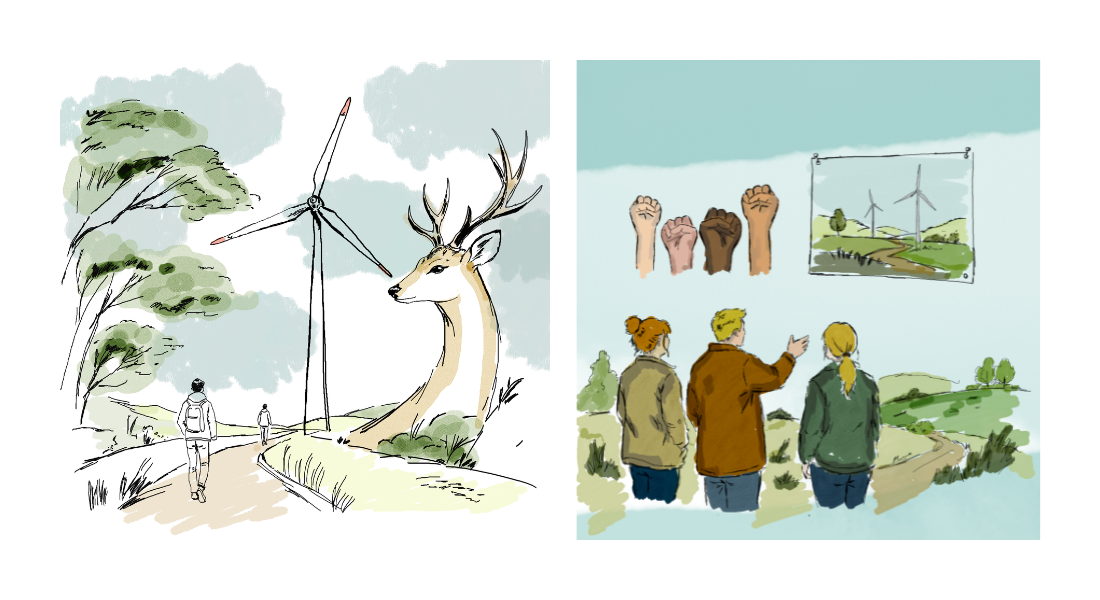
The project MOOW – Model of Democratic Ownership in the Green Transition aims to develop new models for democratic ownership in collaboration with municipalities, companies and citizens. With a grant of DKK 10.6 million, the researchers will examine how citizens can influence changes that affect their everyday lives – and how this can contribute to a more democratically grounded green transition.
“We are seeing increasing attention being paid to the negative consequences that can affect everyday life when green initiatives arrive in local communities. Declining property values, perceptions of unfairness, and polarisation have become closely associated with the green transition. Delays and cancellations of green projects have become part of everyday life in municipalities, and widespread climate fatigue is looming on the horizon. We need to shake things up and bring forward new approaches and perspectives,” says project manager Simon Lex from the Department of Anthropology.
Democratic ownership
The debate on the green transition is often portrayed as a battle between those who support it and those who oppose it. But the reality is more nuanced.
Many local protests are not about opposition to climate action itself, but rather about the feeling that decisions are being made far away and over the heads of the people who will have to live with the consequences.
The project will therefore draw inspiration from different forms of local engagement, such as energy cooperatives, green neighbourhood communities and regenerative agriculture initiatives, where citizens themselves help set the agenda and shape developments.
“We see many committed people who have kick-started local initiatives and strengthened their communities. They are mobilising and taking ownership. We need more of this, but it requires a new, decentralised focus in the development and management of the green transition,” says Simon Lex.
Local focus and a global outlook
The project will engage directly with local communities in Denmark by establishing living labs on Bornholm and in Skive Municipality. Here, citizens, municipalities, businesses and researchers will test new forms of collaboration that balance different interests and perspectives.
Using design methods and workshops, the project will ensure that local experiences become an active part of the roll-out of climate solutions.
In addition to the Danish context, the project includes studies in Germany, Australia and Colombia. These experiences will form the basis for knowledge sharing and exchange across countries and continents.
The project also aims to continuously share insights with decision-makers in municipalities and in the Danish Parliament.
“I hope that we can contribute to policy development so that greater attention is given to the rights, voices and roles of local communities in the green transition. A local centre of gravity should not merely be an ambition: it must also be supported by processes, tools and resources that provide people with real influence and ensure democratic ownership,” says Simon Lex.
Contact
Project manager and Associate Professor Simon Lex
Department of Anthropology
Email: simon.lex@anthro.ku.dk
Phone: +45 35 32 34 58
Communications consultant Lærke Sivkjær
Communication South
Email: kommunikation-soendre@adm.ku.dk